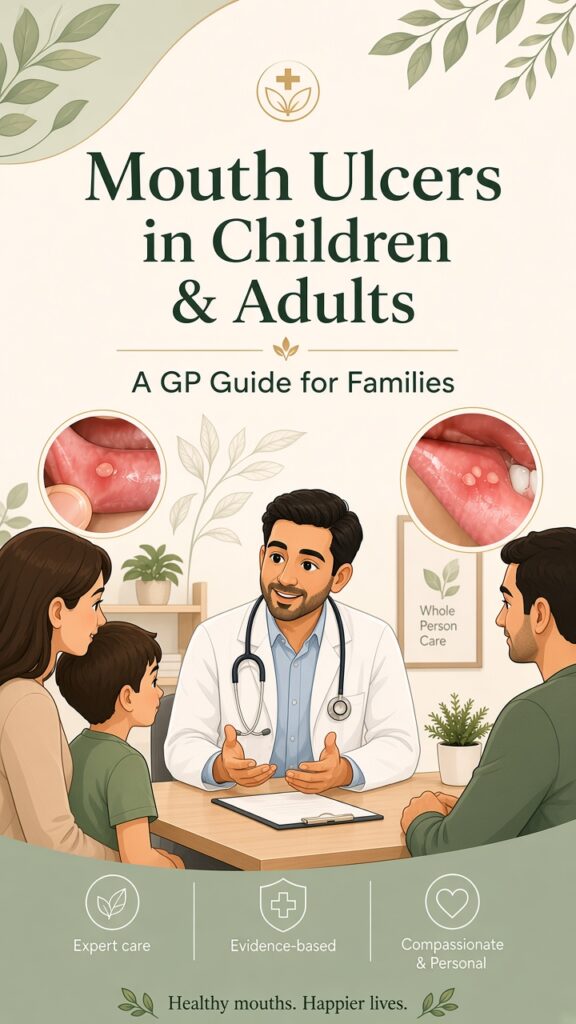
A mouth ulcer can be so small … we barely see it, yet it hurts enough to stop a child from eating, worry a parent, and make an adult’s whole day feel hard. Even simple things like breakfast, brushing teeth, or talking can suddenly hurt a lot.
The good news is that most mouth ulcers are harmless and go away in 1 to 2 weeks. The important thing is knowing when it’s just a normal sore and when it might mean something else …. like dehydration, a vitamin problem, a medicine side effect, a virus, or something that needs to be checked quickly.
What a mouth ulcer really is:
A mouth ulcer is a small break in the soft lining inside your mouth. It usually looks round or oval, with a white, yellow, or grey centre and a red edge. It stings badly when you eat, drink, or use toothpaste.
The most common type is called recurrent aphthous stomatitis (also known as aphthous ulcers or canker sores). These are not contagious. They usually appear on the soft parts of the mouth — inside the lips, cheeks, floor of the mouth, or sides of the tongue.
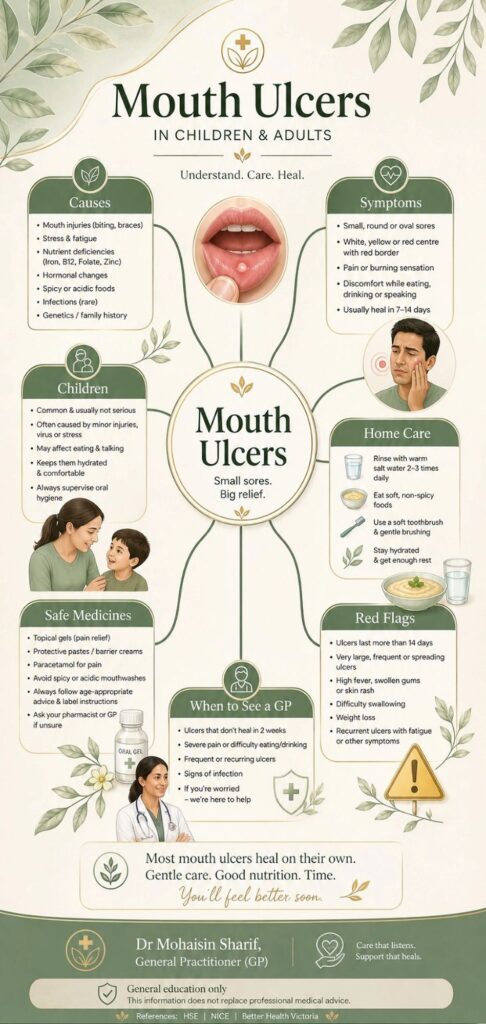
Why do mouth ulcers happen?
Sometimes there is no clear reason. But when ulcers keep coming back, something is usually triggering them. In everyday care, it helps to treat the sore in front of us and also ask why it keeps returning …?
Common triggers include:
- Accidentally biting your cheek or tongue
- A sharp tooth, braces, dentures, or rough dental work rubbing the mouth
- Brushing too hard or using a hard toothbrush
- Stress, poor sleep, or a recent virus
- Hot food or drinks that cause small burns
- Spicy, acidic, salty, or rough foods (like citrus fruit, tomatoes, crisps, and toast)
- Toothpaste that contains sodium lauryl sulphate (SLS), which can irritate some people’s mouths
- Low iron, folate, or vitamin B12 (and sometimes low zinc)
- Certain medicines, including nicorandil, methotrexate, NSAIDs, beta-blockers, and some cancer treatments
If we get ulcers often, one simple change that can help is switching to an SLS-free toothpaste for a few weeks to see if they come less often.
The three patterns or types worth knowing …
Not all mouth ulcers act the same. Some are small and go away fast. Others are deeper, take longer to heal, and need a closer look.
1. Minor aphthous ulcers: These are the small ones. One usually gets 1 to 5 at a time, mostly inside the lips or cheeks. They heal in about 10 to 14 days and don’t leave a scar.
2. Major aphthous ulcers: These are bigger, deeper, and hurt more. They can last weeks or even months and sometimes leave a scar.
3. Herpetiform ulcers: Lots of tiny ulcers that appear in clusters and may join up. They usually heal in 7 to 14 days. Even though the name sounds like herpes, they are not caused by the herpes virus.
This is important because big, deep, or long-lasting ulcers need more care than the common short-lived ones.
When a child has mouth ulcers …
In children, one or two small ulcers with no other symptoms are often just simple aphthous ulcers or a small injury. But if a child suddenly gets many painful ulcers, has a fever, seems very tired, has swollen glands, or a rash on the hands and feet, it may be a viral illness instead of normal recurrent ulcers.
Two common examples are:
- Primary herpetic gingivostomatitis … lots of painful ulcers, fever, and swollen neck glands
- Hand-foot-and-mouth disease … mouth ulcers plus a rash or blisters on the hands and feet
For parents, the biggest worry shouldn’t be the ulcer itself, but It is dehydration. A child with a painful mouth can stop drinking very quickly.
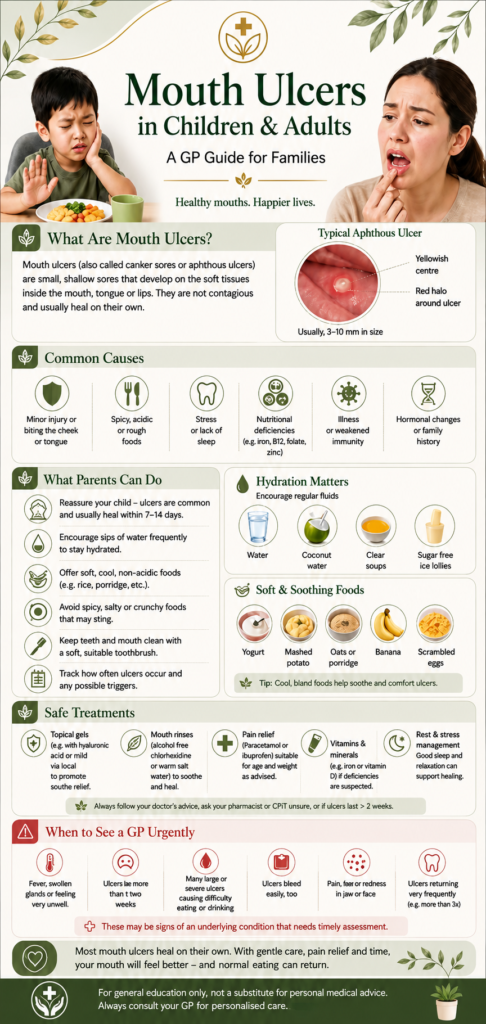
The home-care steps & Remedies that help most …
Most simple ulcers get better with basic care. The goal is to ease the pain, protect the sore, and keep the child (or adult) drinking and eating until it starts to heal.
- Offer cool drinks often. Some children find a straw easier.
- Give soft foods like yoghurt, porridge, mashed potato, rice, custard, smoothies, or cooled soup.
- Avoid citrus, tomatoes, fizzy drinks, spicy foods, crisps, and hard toast while the mouth is sore.
- Use a soft toothbrush and brush gently to keep the mouth clean.
- For older children and adults who can spit, a warm salt-water rinse can help. Mix half a teaspoon of salt in a glass of warm water.
- Use age-appropriate paracetamol or ibuprofen if the pain is stopping sleep, drinking, or eating.
If a child is not eating much for a day or two, that is often okay. But if they are not drinking, become drowsy, pass very little urine, have a very dry mouth, or cry without tears, get medical help urgently — these are signs of dehydration.
⚠️ A safety warning parents should not miss!
Not every over-the-counter mouth gel is safe for children. Adult gels that contain choline salicylate should never be used in children under 16 because of the risk of Reye’s syndrome, a rare but serious condition.
Numbing gels that contain benzocaine or prilocaine also need great care in babies and young children because they can cause a serious problem called methemoglobinemia, which affects how well the blood carries oxygen.
The safest rule is simple …: only use products that clearly say they are suitable for the child’s age. If you are unsure, ask a pharmacist or GP first.
What adults can do for painful ulcers …
Adults can often manage ordinary mouth ulcers with simple self-care and pharmacy treatments. The first step is to avoid things that keep irritating the sore, because ongoing rubbing or chemical irritation slows healing.
Helpful steps (with proper medical advice) include:
- Switching to SLS-free toothpaste
- Avoiding spicy, acidic, and rough foods
- Cutting back on alcohol and avoiding smoking or vaping while the ulcer is there
- Using warm salt-water rinses
- Trying a barrier gel that covers the ulcer and protects it from food and saliva
- Using benzydamine mouthwash or spray for pain relief if suitable
- Using chlorhexidine mouthwash for a short time if advised (it can temporarily stain teeth and should be used at least 30 minutes after brushing)
When a GP may need to investigate further …
Not every person who gets ulcers needs tests, but some do. A GP will think more carefully if the ulcers are frequent, very painful, large, slow to heal, or linked with tiredness, weight loss, bowel symptoms, or poor nutrition.
Depending on the story and examination, useful blood tests may include:
- Full blood count
- Ferritin or iron studies
- Vitamin B12
- Folate
- Coeliac disease screening (especially if there is ongoing diarrhoea, tummy symptoms, unexplained weight loss, or low iron)
Recurrent ulcers can sometimes be an early sign of an underlying problem such as coeliac disease, inflammatory bowel disease, or a nutritional deficiency. In these cases, finding and treating the cause is more important than just treating the ulcer again and again.
Mouth ulcers are not always ‘just ulcers’…
A small number of people with repeated mouth ulcers have a wider inflammatory or autoimmune condition. One important example is Behçet’s disease, where mouth ulcers can come with genital ulcers, eye inflammation, skin problems, or joint symptoms.
Cold sores are different. They usually appear on the outer lip border, are caused by the herpes simplex virus, and respond best to antiviral treatment if started early … ideally within the first 48 hours of tingling or burning.
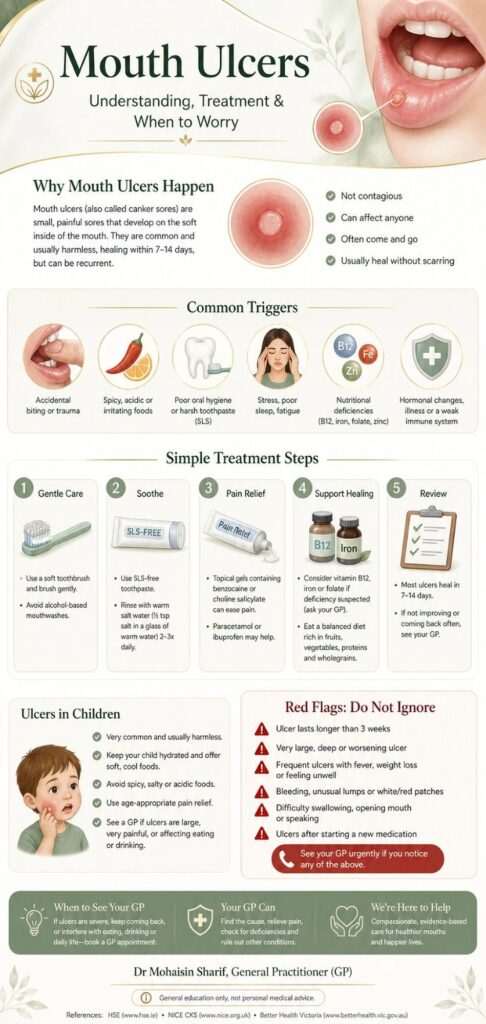
♦️ The Red flags that should never be ignored …!
Most mouth ulcers hurt and heal quickly. An ulcer that is painless, hard, fixed, or still there after more than three weeks needs urgent attention, because a persistent mouth ulcer can be a sign of cancer or another serious disease.
See a GP or Dentist promptly if there is …
- An ulcer lasting more than 3 weeks
- A hard ulcer or one with raised or rolled edges
- A persistent red or white patch in the mouth
- A lump in the neck
- Unexplained weight loss
- Persistent hoarseness
- Recurrent ulcers together with genital ulcers, red eyes, skin rashes, or bowel symptoms
Both UK and Irish guidance say that suspicious mouth ulcers that do not heal should be referred urgently rather than waiting or trying more gels.
The simple take-home Message!
Most mouth ulcers are painful but harmless. Good care starts with fluids, soft foods, gentle brushing, avoiding triggers, and using safe pain relief.
What matters most is knowing when the pattern is no longer simple. Repeated ulcers, large ulcers, ulcers linked with other body symptoms, or any ulcer that lasts longer than three weeks should be checked by a GP or dentist.
References and further reading …
- Health Service Executive (HSE), Ireland. Mouth ulcers: symptoms, causes and treatment
- https://www2.hse.ie/conditions/mouth-ulcers/
- Health Service Executive (HSE), Ireland. Head and Neck Cancer Referral Advice for Primary Care.
- https://www.hse.ie/eng/services/list/5/cancer/profinfo/resources/head%20and%20neck%20cancer%20referral%20advice%20for%20primary%20care.pdf
- NICE Clinical Knowledge Summaries. Aphthous ulcer: management.
- https://cks.nice.org.uk/topics/aphthous-ulcer/management/
- NICE Guideline NG12. Suspected cancer: recognition and referral.
- https://www.nice.org.uk/guidance/ng12/chapter/Recommendations-organised-by-site-of-cancer
- Better Health Channel, Victoria Department of Health, Australia. Mouth ulcers.
- https://www.betterhealth.vic.gov.au/health/conditionsandtreatments/mouth-ulcers
Disclaimer
This article is for general education only and does not replace a medical examination, diagnosis, or personal treatment plan. Seek urgent medical care if a child cannot drink, appears dehydrated, is very unwell, or if any mouth ulcer lasts longer than three weeks.
About the author
Dr Mohaisin Sharif is a General Practitioner (GP) with an interest in patient-centred and rural healthcare. He writes clear, evidence-informed health articles to help parents, families, and patients understand common medical problems and recognise when professional care is needed.