
A GP Dad’s Calm Guide to the Late Talker
Our toddler understands us.
He (The Late Talker) brings his shoes when we ask. He knows where the snacks are. He laughs at the right moment in his favourite cartoon. He looks at the door when we say, “Baba is home.”
But when we wait for a word, the room stays quiet.
If this is our child, we take a breath. Understanding more than a child can say is common. It is not an emergency tonight, and it does not automatically mean autism or a serious problem.
But it is also not something to quietly ignore until age three.
This is the calm middle ground: no panic, no blaming, no waiting forever.
The family stories are kind — but not a plan
In one home, a grandmother says, “He understands everything, mashallah. Words will come.”
In another, an uncle says, “I did not talk until I was three. Now I am fine.”
Someone says, “He is just a boy.”
Someone else says, “There are too many languages at home.”
These words usually come from love. Families want to reassure us. And sometimes they are right: children can develop at different speeds.
But family stories cannot check hearing. They cannot assess speech and language. They cannot tell which child will catch up easily and which child needs support.
A referral is not a label.
It is simply a closer look.
What “late talker” means
Children understand language before they can speak it. This is normal.
We call understanding receptive language. It includes knowing familiar words, following simple instructions, and understanding routines.
We call speaking expressive language. It includes sounds, gestures, words, signs, and little phrases such as “more milk” or “Daddy go.”
A child may be good at understanding but late to talk. That can be reassuring — but it is still worth checking if the gap is large.
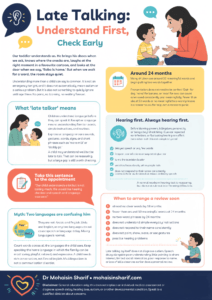
By around 24 months, many children use around 50 meaningful words and begin putting two words together. They do not need to pronounce every word clearly. “Dah” for dog, “nana” for banana, or “moo” for cow can count when used consistently and meaningfully.
At 24 months, fewer than about 50 words or no meaningful two-word phrases is a reason to ask for help — not a reason to panic.
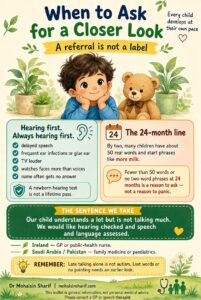
Hearing first. Always hearing first.
Before blaming screens, bilingualism, personality, or “being a boy,” we check hearing.
A child does not need to be completely deaf for hearing to affect talking. Glue ear, repeated ear infections, or fluctuating hearing can make speech sound unclear, distant, or inconsistent.
We ask for a hearing check if our child:
- Has delayed speech or very few words
- Has had frequent ear infections or suspected glue ear
- Turns the television louder
- Watches faces closely when people talk
- Does not respond to their name consistently
- Seems to hear loud noises but misses ordinary speech
A normal newborn hearing test is reassuring, but it does not rule out hearing difficulties later. Glue ear can affect hearing and is linked with delayed speech and language development.
We take this sentence to the appointment:
“Our child understands a lot but is not talking much. We would like hearing checked and speech and language assessed.”
Myth: “Two languages are confusing him”
They are not.
Growing up with Arabic and English, Urdu and English, or any two languages does not cause speech or language delay.
A bilingual child may mix languages. They may know “water” in one language and “pani” in another. That is normal. We count words across all the languages our child uses.
We do not stop speaking our home language to “help” English. We speak the language in which we can be most loving, playful, relaxed, and expressive.
A child needs rich conversation, not forced English.
Multilingualism is not a communication disorder.
What to do at home
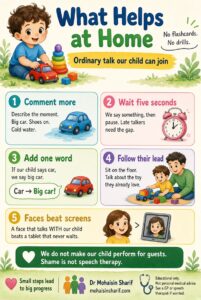
We do not need flashcards or drills. We need small, ordinary conversations our child can join.
Comment more, test less
Instead of asking, “What is this?” all day, we describe what is happening.
- “Big car.”
- “Shoes on.”
- “Cold water.”
- “Dog running.”
- “You want more.”
Comments are easier to join than questions.
Wait
We say something, then pause for five seconds.
It may feel long. But children who are late to talk often need a little more time to process, plan, and try.
Waiting gives them space.
Add one word
If our child says “car,” we say, “Big car.”
If they say “milk,” we say, “More milk.”
If they point, we give the word: “Ball. You want ball.”
We do not force repetition. We model it warmly and move on.
Follow their lead
We sit on the floor. We watch what interests them. We talk about that.
If they love cars, we do not need to teach colours or animals. We can say, “Car go,” “Fast car,” “Car stuck,” and “More car.”
Language grows best inside connection.
Reduce the screen that talks at them
A face that talks with our child beats a tablet that never waits.
Screens are not the cause of every delay. But they can replace the back-and-forth talking that toddlers need. We keep television and phones off during play and meals where possible.
If our child watches something, we watch together sometimes. We name what we see. We laugh, point, and talk about it.
When to be seen sooner
We arrange a review soon if our child:
- Has almost no clear words by 18 months
- Has fewer than around 50 meaningful words at 24 months
- Is not using two-word phrases by 24 months
- Does not understand simple everyday instructions
- Does not respond to their name consistently
- Does not point, show, wave, or use gestures
- Has lost words, gestures, eye contact, or social interest
- Has possible hearing problems
- Rarely brings us into play or has very limited pretend play
- Is frustrated often because they cannot be understood
Late talking by itself does not diagnose autism.
But speech delay alongside poor understanding, little pointing to share interest, limited social interaction, poor response to name, or loss of skills deserves earlier developmental review.
The next step is simple
If we are in Ireland, we speak to our GP or public-health nurse. We can also ask our local HSE primary-care centre about children’s speech and language therapy referral routes.
If we are in Saudi Arabia, Pakistan, or elsewhere, we start with family medicine or paediatrics. We ask directly for hearing and speech/language assessment.
We bring a short note:
- Words our child says
- Things our child understands
- How our child asks for things
- Whether our child points or shows things
- Ear infections or hearing concerns
- Any lost skills
A short video of ordinary play at home can also help. Children do not always show their usual communication in a clinic room.
A final word from one parent to another
Our child is not failing us.
We have not failed our child.
We do not make them perform for guests: “Say Mama. Say it again.” Shame is not speech therapy.
We do not stop our home language.
We do not wait only because someone’s uncle spoke late.
We thank the family for caring. Then we keep the appointment.
Words come at different speeds. But the next few months are still ours to use well.
About the author
Dr Mohaisin Sharif is a general practitioner and medical writer with clinical experience in family practice in Pakistan and Saudi Arabia. He writes clear, evidence-based health guides for parents and families.
Disclaimer
This article is for general education and does not replace an individual medical assessment. It cannot diagnose speech delay, hearing loss, autism, or another developmental condition. If we are concerned about our child’s talking, understanding, hearing, social interaction, play, or loss of skills, we speak to a GP, public-health nurse, paediatrician, audiologist, or speech and language therapist.
References
- American Speech-Language-Hearing Association. Communication Milestones: 19 to 24 Months.
- Liang WHK, et al. Speech and language delay in children: a practical framework for primary care physicians.
- NICE. Otitis media with effusion in under 12s.
- Health Service Executive Ireland. 12 to 24 months: How to help your child’s communication.
- American Speech-Language-Hearing Association. Spoken Language Disorders; Multilingual Service Delivery.