
A baby is not a savings account. We cannot deposit health as extra fat and withdraw it later …
Someone leans in, pinches our baby’s soft cheek, and delivers the verdict.
“Look at those rolls … such a healthy child.”
Or the comment that lands like a small weight on our chest: “This one seems a little thin. Are you sure they’re eating enough …?”
Actually, Nobody in that room is being unkind. But a cheek pinch is not a medical test, and somewhere between the compliment and the concern, a parent quietly decides to add one more bottle or feed tonight.
That extra bottle is where this story starts.
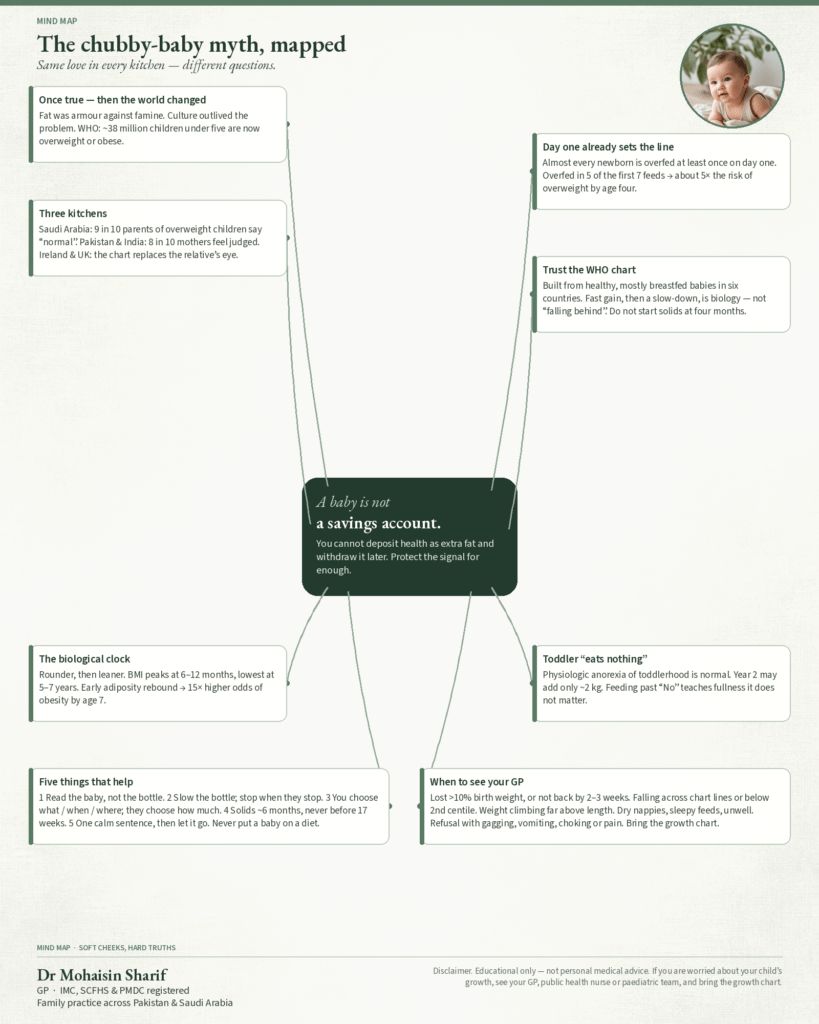
The myth was once true … then the world changed
Extra fat used to be armour. For most of human history, babies died of hunger and infections. A plump baby carried an energy reserve to survive a fever or a failed harvest. Chubby genuinely meant more likely to live.
So the belief hardened into the culture, and culture is stubborn unfortunately … it outlives the problem it was built to solve.
Today the WHO counts roughly 38 million children under five who are overweight or obese. The famine our ancestors feared is rarely at the door anymore. But the reflex is still there, speaking in the voice of someone we love & care.
Three kitchens, and one strange belief …
In Saudi Arabia, a larger child reads as prosperity. The blind spot is remarkable, up to 9 in 10 parents of overweight children describe them as normal weight. The eye simply calibrates to the room, and the room has changed.
In Pakistan & India, the pressure comes from extended family … and it is loud. Nearly 8 in 10 mothers report feeling judged about their child’s weight. Many know the health risks, yet get overruled at the dinner table. A mother’s competence is being graded, in public, in kilograms.
In Ireland & UK, the question is handed to a chart. A nurse plots weight and length, and the answer stops being “does this baby look right to relatives” and becomes “is this baby tracking along their own line.” It isn’t warmer. It’s just harder to argue with.
Same love in all three kitchens. But very different questions being asked.
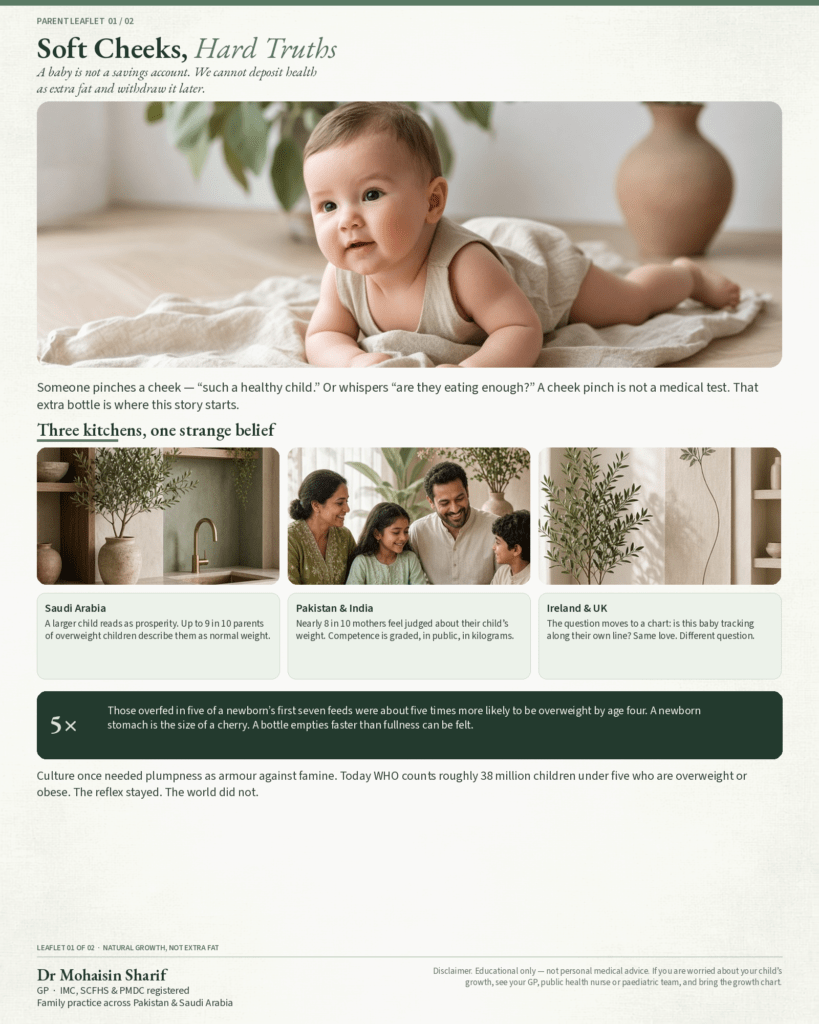
The first week already sets the trajectory
Here is the finding that changed how I think about this.
Researchers looked at a newborn’s first seven feeds. Almost all babies were overfed at least once on day one. Those overfed in five of those first seven feeds were roughly five times more likely to be overweight by age four.
Day one. Before anyone had decided anything about parenting.
Not because parents were careless, but because a newborn’s stomach is the size of a cherry, a bottle empties faster than fullness can be felt, and everyone in the room is anxious.
Why the growth chart is on your side
Most of Advanced Healthcare setups use WHO growth Charts, built from healthy, mostly breastfed babies across six countries …. They describe how a baby should grow, not how the roundest cousin happened to grow.
Breastfed babies gain quickly for 2–3 months, then naturally slow down. That deceleration is normal biology. On older, formula-weighted charts it can look like “falling behind” … triggering panic top-up bottles, cereal in milk, or solids at four months.
The healthy thing gets mistaken for the failing thing. Then we treat it.
The biological clock nobody mentions …
Babies get rounder, then they get leaner. That’s not a diet … it’s the design.
Body mass index peaks around 6–12 months, falls through toddlerhood, and hits its lowest point around age 5–7. Then it rises again toward puberty. That second rise is called adiposity rebound.
When it arrives early … before about five and a half years, the risk of lifelong obesity climbs steeply. In one large study, children with a very early rebound had 15 times higher odds of obesity by age 7.
Keeping a toddler as round as they were at 9 months isn’t neutral. It works against a clock that was already running correctly.
The toddler who suddenly “eats nothing” …
Around the first birthday, appetite falls off a cliff. It’s called physiologic anorexia of toddlerhood … and it’s normal.
In year one, a baby triples their birth weight. In year two, they might gain only 2 kg total, and can go months gaining almost nothing. Growth slowed down, so hunger slowed down. The brain is doing its job.
To worried families … this looks like illness or defiance. So out come … the night feeds, the cartoons as distraction, the spoon flown in behind a laugh.
The real cost? A child repeatedly fed past ‘NO!’ … learns their own fullness signal doesn’t matter. That lesson doesn’t expire at five. It shows up decades later, at midnight, in front of an open fridge.
Five things that actually help
1. Read the baby, not the bottle: Hunger is rooting, fists to mouth, fussing. Full is turning away, slow sucks, sealed lips. Milk left in the bottle is a fed baby, not waste.
2. Slow the bottle down: Sit baby semi-upright. Hold the bottle almost flat so they have to work for milk, like breastfeeding. Pause every 20–30 seconds. Stop when they stop.
3. You choose what, when and where, Babies choose whether and how much …: Serve meals at the table, on schedule, no screens. They decide how much goes in. No second kitchen, no bargaining, no dessert bribes.
4. Don’t rush solids: Around 6 months … Never before 17 weeks. Wait for the signs: sitting with support, steady head, hand to mouth. Milk is still the main nutrition until one year. Early solids are about iron and skill, not fattening.
5. Say the sentence once, then let it go …: “I know it comes from love. The nurse plotted the chart, and the baby is growing on their own line. What helps most is floor time and play.” One line from a doctor settles more arguments than an hour of evidence.
Never put a baby on a diet. The goal is a normal pace, not the weight loss.
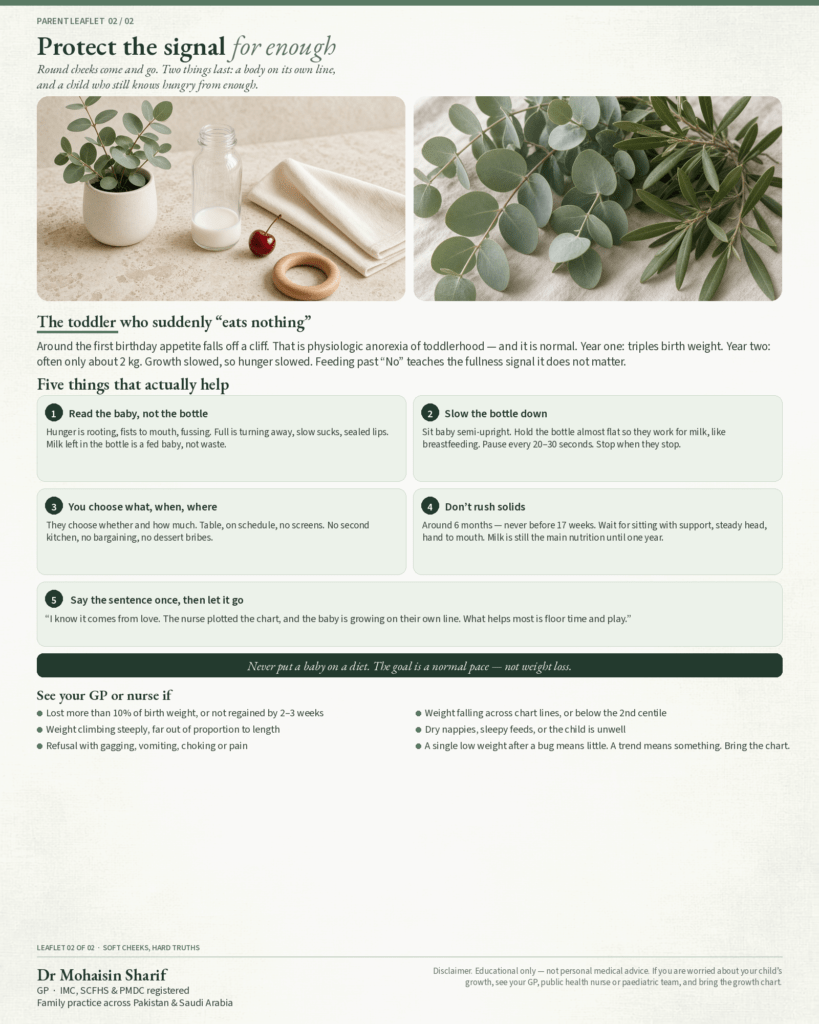
When it is worth worrying
See your GP or Nurse if:
- Newborn lost more than 10% of birth weight, or hasn’t regained it by 2–3 weeks
- Weight is falling across chart lines, or sits below the 2nd centile
- Weight is climbing steeply, far out of proportion to length
- Nappies are dry, feeds are sleepy, or your child is unwell
- Refusal comes with gagging, vomiting, choking, or pain
Bring the growth chart. A single low weight after a bug means little. A trend means something.
The thought I’ll leave you with …
A baby is not a savings account. You cannot deposit health as extra fat and withdraw it later.
Round cheeks come and go. Two things last …: a body that grows along its own natural line, and a child who still knows the difference between hungry and enough.
Protect the second one. It’s the harder one to get back.
About the author
Dr Mohaisin Sharif is a general practitioner (IMC, SCFHS and PMDC registered) and medical writer with clinical experience across family practice in Pakistan and Saudi Arabia. He writes plain-language, evidence-based guides for families … the kind of calm, practical conversation that belongs in a clinic room.
Disclaimer: This article is for educational purposes only and does not constitute personal medical advice. If you are worried about your child’s growth or health, please consult your GP, public health nurse, or paediatric team, and bring your growth chart along.