
It’s never laziness. The hidden cause 80% of families miss, red flags to watch for, and the simple plan that works in every healthcare system I’ve practiced in.
As a GP with 5+ years across primary care clinics in Pakistan and Jeddah, registered with the Irish Medical Council, and dad to 3 kids myself, I’ve sat across from hundreds of parents carrying this exact quiet weight.
They lean in, voice low, embarrassed: ‘He still wets the bed at 7’.
‘She soils her underwear at school and won’t tell anyone’.
‘We’ve punished, we’ve rewarded, nothing works … is there something wrong with him’?
Let me open with the line I say to every single one of these families, because it’s the most important thing you’ll read here:
✅ This is common. This is treatable. And your child is not doing this on purpose. This is never laziness, never bad behavior — it is a health issue.
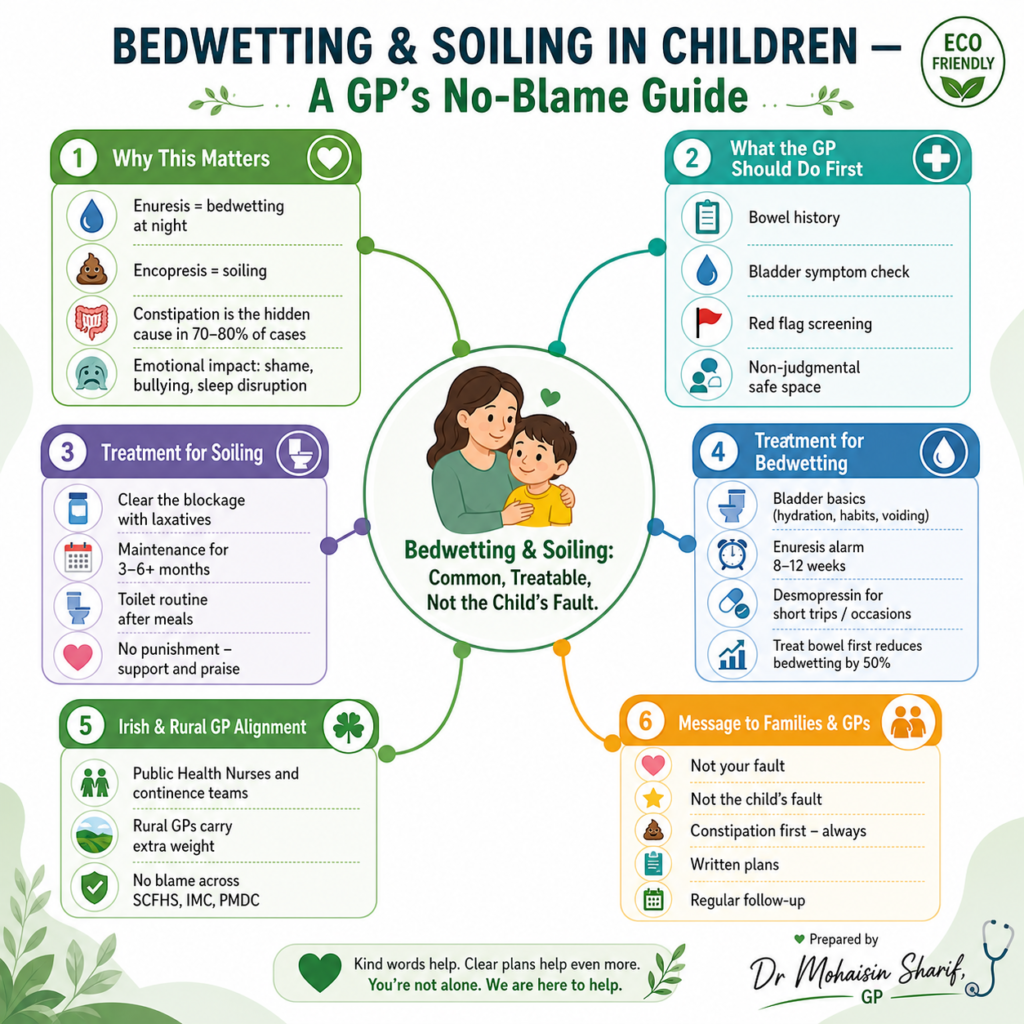
Why this matters (and why so many families suffer in silence)
Two clinical terms frame what we’re dealing with, and naming them takes away half the shame:
Enuresis: Bedwetting at night, beyond the age most children stay dry (typically 5 years old)
Encopresis: Soiling or accidental stool leakage, often into underwear, that the child may not even feel happening.
These are two of the most frequent childhood presentations I see in general practice — and they are almost always deeply connected. The hidden culprit in 70–80% of soiling cases, and a top trigger for worse bedwetting, is constipation.
Here’s what most parents don’t know: Hard, stuck stool stretches the rectum, blunts the nerve sensation that tells a child “I need to poop,” and lets liquid stool leak around the blockage without them noticing. That same full bowel presses on the bladder, triggering urgency, frequency, and more overnight accidents.
The emotional cost matches the physical one: shame, school bullying, sleep disruption, family stress, and kids withdrawing from friends or overnight stays. In Jeddah’s expat communities and Pakistan’s smaller towns, I see families wait 6+ months to seek help because they fear judgment — that delay only makes the pattern harder to break.
What your GP should do first (no unnecessary tests, no shame)
Whether you’re seeing a doctor in Lahore, Jeddah, or Dublin, the gold-standard primary care approach is the same: gentle, structured, and focused on root causes.
- Full bowel history first: How often does stool pass? Is it hard, painful, or large enough to clog the toilet? Does the child withhold, cross their legs, or hide to poop?
- Bladder symptom check: Daytime urgency, frequency, or accidental wetting tells us the bladder is also involved, not just the bowel.
- Red flag screening: Poor weight gain, vomiting, blood in stool, recurrent UTIs, neurological signs (leg weakness, gait changes), or new onset after 6+ months of being dry — these trigger faster review or referral.
- A safe, non-judgmental space: I make a point to tell the child directly, “You are not in trouble. This is my job to help fix with you.” Half the battle is getting them to stop hiding accidents.
In routine cases, invasive tests are almost never needed first. Good history-taking beats every scan or lab.
The simple treatment plan that works (I use this in every clinic)
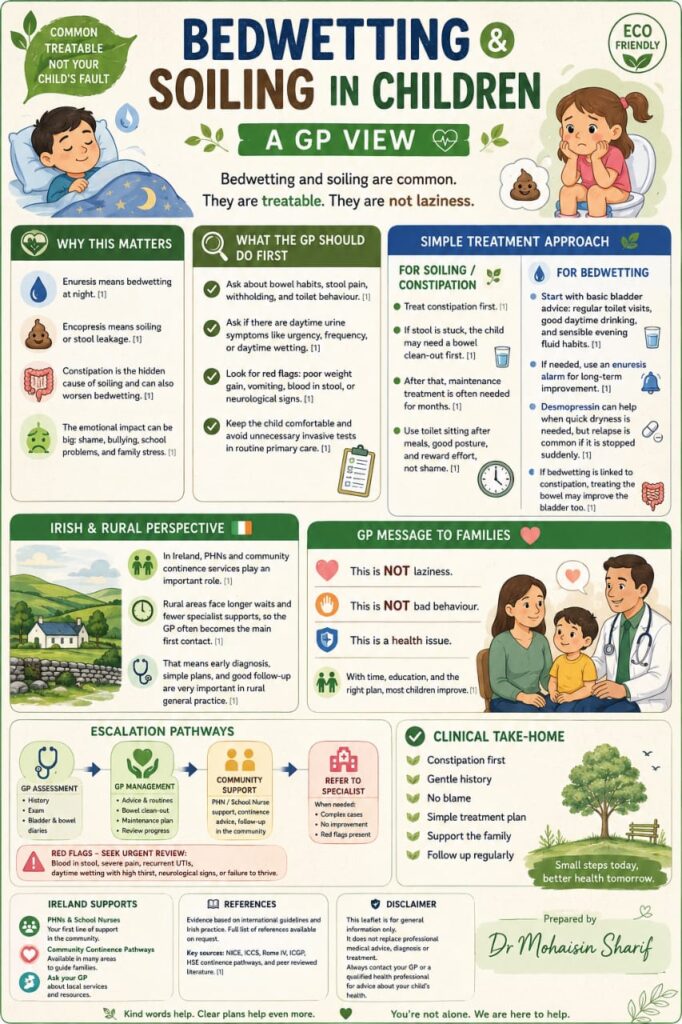
We always fix the bowel first — ignore constipation, and neither bedwetting nor soiling will get better long-term.
For Soiling & Constipation:
- Clear the blockage: If stool is impacted, your GP may prescribe a short bowel clean-out with osmotic laxatives to shrink the rectum back to normal size.
- Maintenance for months: This is the step 90% of families quit too early. Most kids need low-dose daily laxatives for 3–6+ months to prevent re-blocking — stopping as soon as they’re dry guarantees relapse.
- Routine over punishment: 5–10 minutes of toilet sitting immediately after meals (when the gut’s natural reflex kicks in), foot support so knees are higher than hips, and rewards for effort (sitting, trying) — never punishment for accidents.
For Bedwetting:
- Bladder basics:Regular toilet visits every 2–3 hours, plenty of water during the day, and cutting sugary/caffeinated drinks 2–3 hours before bed.
- Enuresis alarm: The gold standard for long-term cure. It wakes the child at the first drop of wetness, retraining the brain-bladder connection over 8–12 weeks.
- Desmopressin: Short-term option for sleepovers, school trips, or camps — it cuts overnight urine output fast, but relapses are common if stopped abruptly.
- Treat the bowel first: When constipation is present, fixing it alone reduces bedwetting episodes by 50% or more in most kids, no bladder treatment needed.
What I’ve learned aligning this with Irish general practice guidelines:
- As I prepare to move into Irish GP training, I’ve mapped this approach against ICGP (Irish College of General Practitioners) and NICE guidelines — and the core lessons are universal, with key takeaways for every family:
- Community teams are superpowers: In Ireland, Public Health Nurses (PHNs) and continence services run structured family support programs, often before specialist referral is needed.
- Rural GPs carry extra weight: In rural Pakistan, rural Ireland, and even outer Jeddah, long specialist waits mean the GP is the long-term care lead — early diagnosis, simple written plans, and regular follow-up become even more critical.
- No blame is non-negotiable: Every regulator I’m registered with (SCFHS, IMC, PMDC) frames this as a chronic health condition, not a parenting failure — it’s the standard every family deserves, everywhere.
My message to families (and to my fellow GPs):
To the parents reading this at 2 a.m. after changing another set of sheets:
❌ This is not your fault
❌ This is not your child’s fault
✅ This is fixable, with time, consistency, and the right GP plan
To my fellow IMGs and primary care colleagues: Our job is not just to prescribe laxatives or alarms. It’s to take the shame out of the room, give families a clear, simple plan they can stick to, and follow up until it works. The clinical take-home never changes:
- Constipation first — always!
- Gentle history, no judgment!
- Written plans, not just verbal advice!
- Support the whole family, not just the child!
- Regular follow-up until stable!
Small steps today, better health tomorrow.
Evidence Base
- NICE Guideline NG113: Nocturnal enuresis in children and young people
- Irish College of General Practitioners (ICGP): Continence care pathways for primary care
- World Health Organization (WHO): Management of childhood functional constipation
- Rome IV Criteria: Functional gastrointestinal disorders in children
⚠️ General educational information only — not personalized medical advice, diagnosis, or treatment. Always consult a licensed GP or qualified healthcare provider for your child’s specific needs. No patient-identifiable data included.
🛡️ Dr. Mohaisin Sharif is a General Practitioner registered with the Pakistan Medical & Dental Council (PMDC), Saudi Commission for Health Specialties (SCFHS), and Irish Medical Council (IMC). This content reflects general primary care guidance based on peer-reviewed international guidelines. It does not create a doctor-patient relationship, and should not replace in-person assessment by a licensed healthcare provider in your jurisdiction. All content is within the scope of general practice; no specialist advice is provided.