
Why parents hesitate on vaccines, what actually changes their minds, and why arguing isn’t helping …?
If we spend five minutes on social media searching for vaccination, we see people screaming about it like it’s the World Cup final. One side calls parents selfish anti-vaxxers. The other calls doctors blind followers. In Reality … both sides are missing the Truth unfortunately.
Every year, millions of children don’t get the shots that could save their lives. In 2025 alone, 13.5 million babies got zero vaccines. And here’s what nobody likes to admit … it’s almost never because parents don’t love their kids. It’s because fear, confusion, and broken trust are simply louder than facts alone.
As a doctor, I’ve sat across …. so many worried parents. They’re not stubborn. They’re not against anything. They’re just scared or misguided unfortunately.
The Problem With Picking Teams
Some People like to put parents into neat boxes … those who vaccinate and those who don’t. But real life doesn’t work like that. Actually it’s more like organizing a big family dinner, where everyone has their own reasons … and their own someone who told them something scaring at the last wedding.
Let’s just assume and try to realise ….
- Some parents are terrified the shot will hurt their baby.
- Some live three hours from the nearest clinic and can’t afford the bus fare.
- Some heard a rumor from their neighbor or local religious leader and thought … Well, they wouldn’t lie to me.
- Some want to vaccinate, but their husband or child’s grandfather says absolutely not, and that’s the final word.
These are completely different problems. They need completely different answers. Lumping everyone into ‘Team NO’ helps nobody.
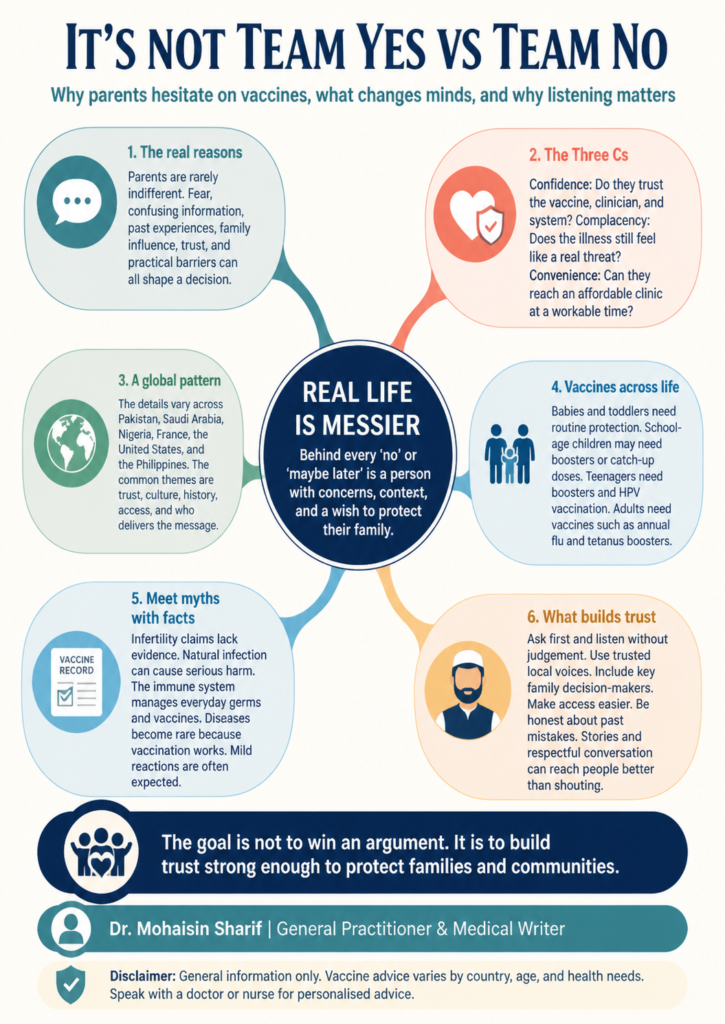
The Three Simple Reasons Parents Say … ‘Maybe Not’
Doctors have a simple framework for this to categories
- Trust: Does the parent trust the doctor, the clinic, or the system? If someone doubted them before, they wouldn’t line up for seconds.
- Is this sickness even real?: If nobody in their neighborhood hasn’t had polio in 20 years, they start thinking, Why bother?
- Can they actually get there?: Is the clinic close? Affordable? Open when they’re not working?
If we don’t know which is the real problem, we can’t fix it. Telling a mom vaccines are safe! is useless when her real problem is she can’t pay for the bus to the clinic. That’s like telling someone who’s hungry, ‘Just eat a salad!’ … while they’re standing in an empty kitchen.
Around the World: Same Problem, Different Scenarios …
Vaccine hesitancy doesn’t care about borders or bank accounts. It looks different everywhere, but the pattern is the same: For Example …
🇵🇰 Pakistan: Polio cases dropped from 74 in 2024 to 31 in 2025 … real progress. But rumors persist that polio drops cause infertility, a suspicion fueled by a 2011 fake vaccine team used for a spy mission. In some homes, mothers want to vaccinate but fathers or grandfathers say no. It’s not about medicine … it’s about trust and who gets to decide.
🇸🇦 Saudi Arabia: Excellent hospitals, easy access … yet many parents still hesitate. Their fears? Side effects, too many shots at once, and things read online. The lesson is … having a hospital nearby isn’t enough. Parents also need to trust what they’re told.
🇳🇬 Nigeria: In the early 2000s, some religious leaders claimed vaccines were a Western plot to sterilize Muslim children. It took years of working with trusted local scholars to rebuild confidence.
🇫🇷 France: A wealthy nation with great healthcare … yet some of Europe’s highest hesitancy rates. Many French parents prefer ‘natural’ approaches, distrust pharmaceutical companies, and believe getting sick is somehow safer than a shot.
🇺🇸 United States: Hesitancy has become tangled in politics and social media echo chambers. A parent starts with one genuine question, and suddenly their entire feed is filled with extreme content. When public health becomes a political issue, nobody wins … especially not the kids.
🇵🇭 Philippines: A 2017 dengue vaccine scandal shattered trust in all vaccines, not just the one involved. Measles cases surged as parents became afraid to vaccinate. One bad experience ripples outward.
The pattern everywhere … It’s almost never about parents not caring. It’s about trust, culture, past mistakes, and who’s delivering the message.
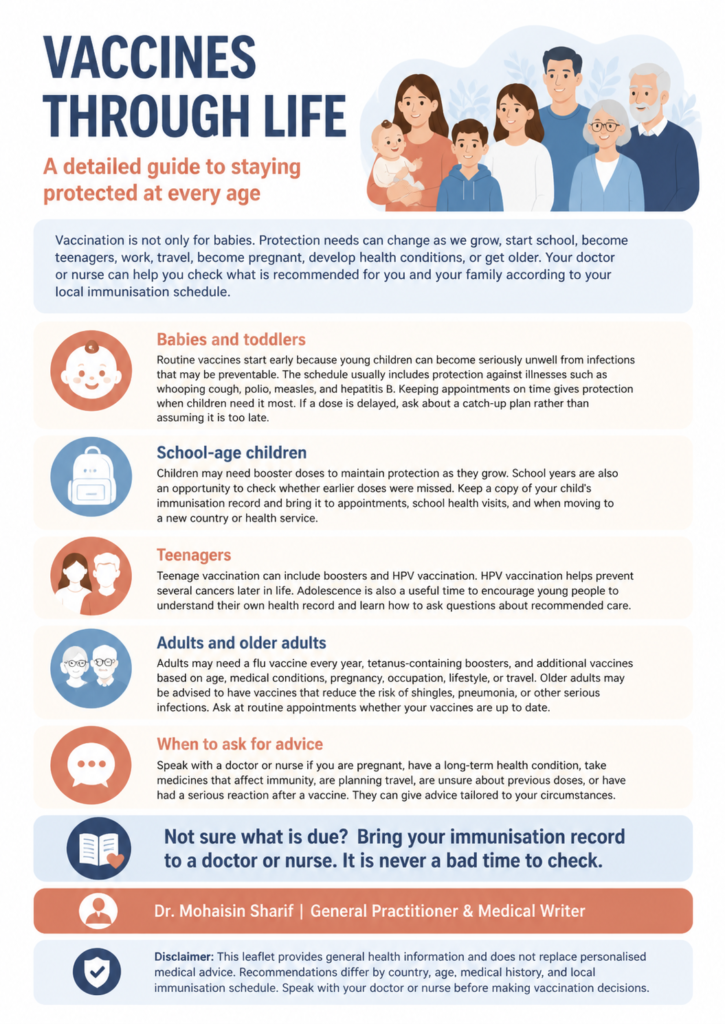
Which Shots Really Matter … At Every Age
Vaccines aren’t just for babies. Think of it like car maintenance … different needs at different mileages!
👶 Babies & Toddlers: Core protection against whooping cough, polio, measles, and liver disease … starting at birth. These are the seatbelts of childhood health … Actually non-negotiable!
👧 School-Age Kids: Boosters and catch-up shots. Like topping up your oil … keeps protection from fading.
🧑 Teenagers: So many parents miss this …! Teens need a booster to keep protection strong, plus the HPV vaccine that prevents cancer later in life. Yes … cancer. This is a big one.
👨👩 Adults: Vaccines aren’t just for kids …! Everyone needs a flu shot every year (flu changes its outfit annually, like a fashionista), a tetanus booster every 10 years, and for older adults, shots to prevent shingles and pneumonia. Our future self will thank us.
Let’s Bust Those Big Scary Myths …
I’ve heard every fear in the book. Let’s answer them plainly, like chatting over tea …:
❌ Vaccines cause infertility ….?
Truth: Nope. Zero evidence. This rumor is like the spider-in-the-haircut story … everyone’s heard it, but it never happened to anyone they know.
❌ Getting sick naturally is safer …?
Truth: If only … The real disease can cause brain damage, paralysis, or death. The shot is like a fire drill for the immune system … to practice without the actual fire.
❌ Too many shots overload the body …?
Truth: Our children fights off hundreds of germs daily just from playing outside. A vaccine is a tiny training exercise compared to what out body already handles like a champ.
❌ If the disease is rare now, we don’t need the shot …?
Truth: It’s rare because of the vaccine …! That’s like saying, My umbrella works great … so I’ll throw it away … it’s not raining anymore.
❌ Fever or crying after … means something went wrong …?
Truth: It means something went right. A mild reaction is the body saying, I see this germ, and I’m learning to fight it! Like sore muscles after the gym … annoying, but a good sign.
What Actually Helps … And What Doesn’t
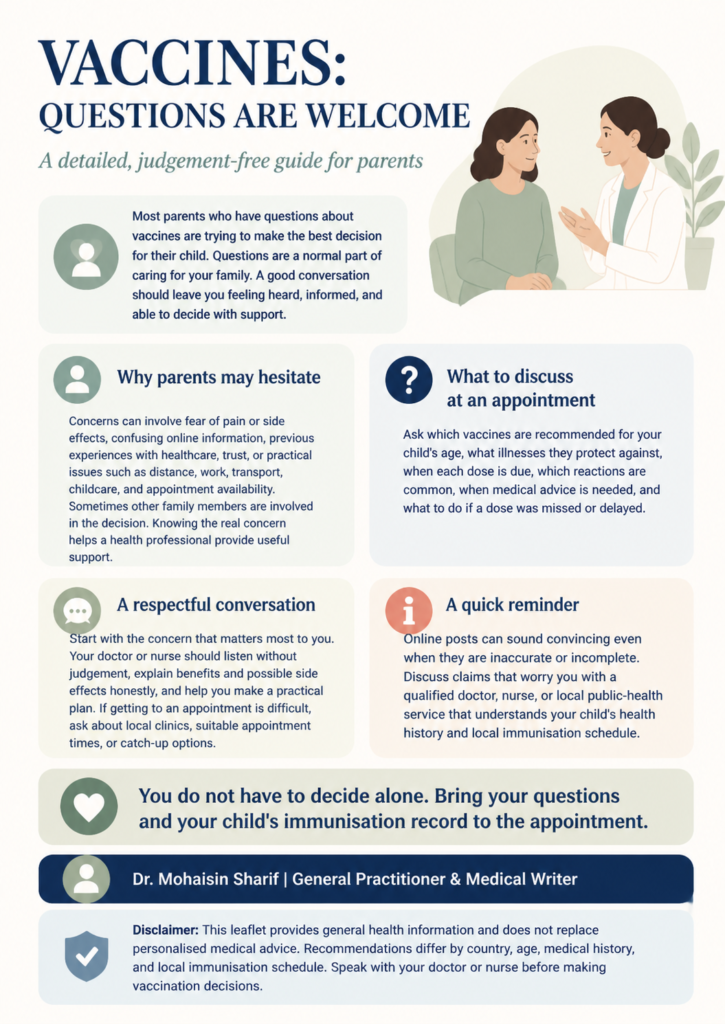
What doesn’t work: Yelling, Name-calling, Making parents feel bad, Fear based messages.
What does work …
- Trusted local voices: When the imam, priest, teacher, or community elder speaks, parents listen. They trust their community more than a stranger in a suit.
- Ask first, lecture second: Try ‘What have you heard that worries you …’? instead of jumping into a speech.
- Make it easy: Mobile clinics, evening hours, free transport … Don’t make vaccination feel like climbing a mountain.
- Talk to both parents: If Dad or Grandpa makes the final call, he needs to hear the message too.
- Be honest about the past: When trust was broken, admit it. People respect honesty more than perfect pretend.
- Stories beat statistics: A picture of a healthy local child works better than a chart with 100 numbers. Humans are wired for stories, not spreadsheets.
Take Home Message
This isn’t about picking teams. It’s about understanding that behind every NO or maybe later is a real person with real fears … whether they live in Lahore, Riyadh, Lagos, Paris, or Los Angeles.
Vaccination isn’t about winning an argument online. It’s about preventing paralysis, brain damage, cancer, and unnecessary death. The solution isn’t to create Confusion … it’s trust, honesty, and showing up for communities in ways that respect their concerns.
The real question isn’t whether vaccines work …. We know they do …. The real question is whether we can stop yelling long enough to listen, and then work together to make trust stronger than a rumor … everywhere.
About the Author
I’m Dr. Mohaisin Sharif, a general practitioner and medical writer. I believe good health information shouldn’t sound like a university textbook. It should be simple enough for any parent to understand … not just doctors.
DISCLAIMER
This article is written solely to help families understand vaccines in simple language. It is not a replacement for advice from your own doctor. Vaccine advice can differ depending on your country, your child’s age, and their health. Always talk to a doctor or nurse before making decisions about vaccines for yourself or your child.