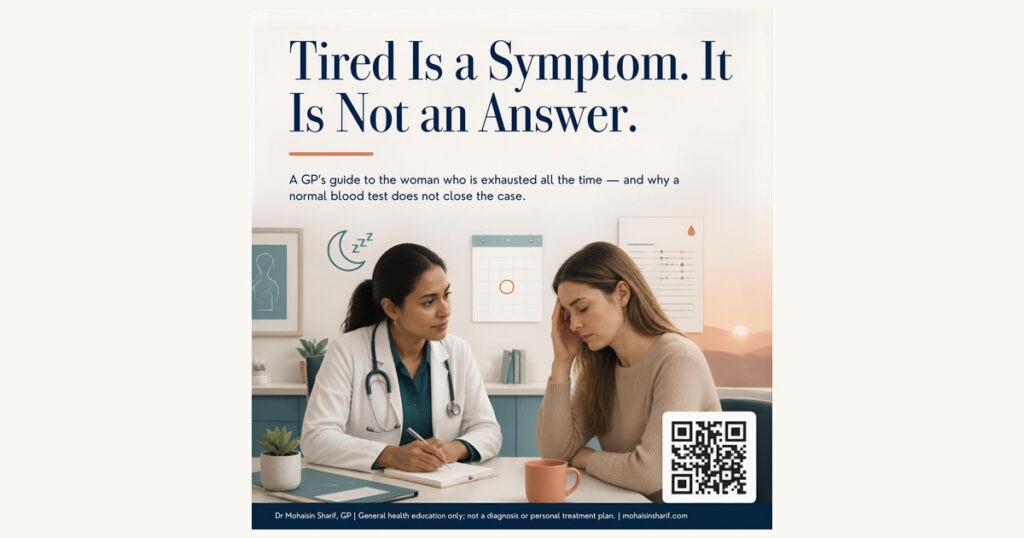
A GP’s guide to the woman who is exhausted all the time … and why a normal blood test does not close the case.
A woman sits down in clinic.
It could be Lahore. It could be Jeddah, where I work now. One day it may be a small practice in rural Ireland (hopefully).
She has already rehearsed the sentence on the way in.
“Doctor, I’m just tired all the time.”
Someone has usually explained it away before she arrives …
“You have children.”
“You work too much.”
“It’s stress.”
“It’s your age.”
“Your blood tests were normal.” & etc.
Normal blood tests and genuine exhaustion can live in the same person. Tiredness is often ordinary.
Persistent fatigue is not a personality trait. It is a symptom … and a symptom deserves curiosity, not a shrug.
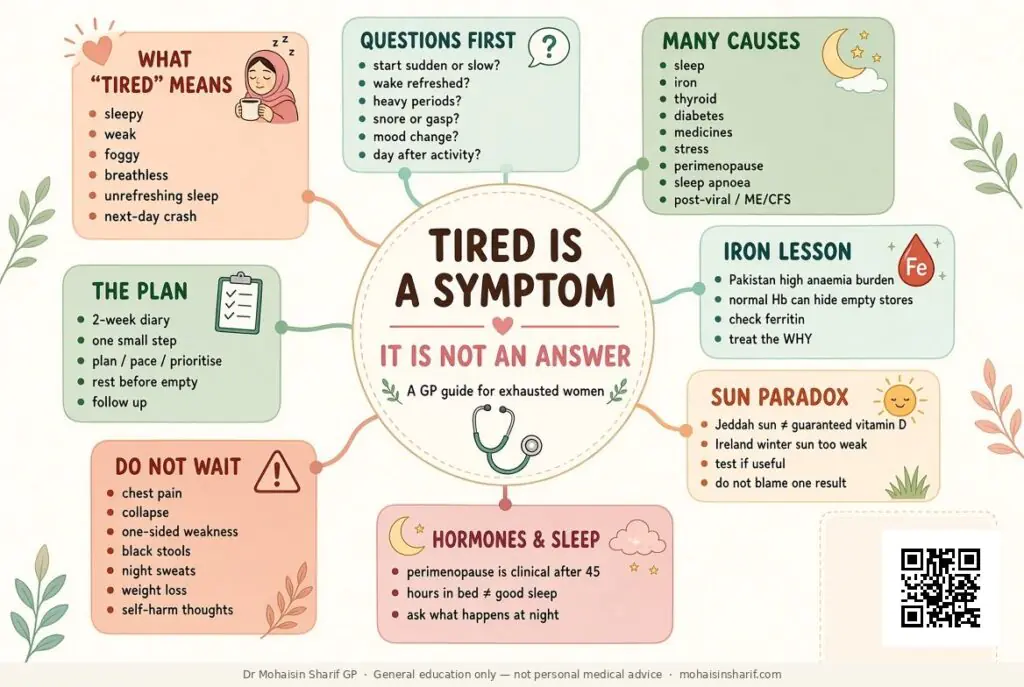
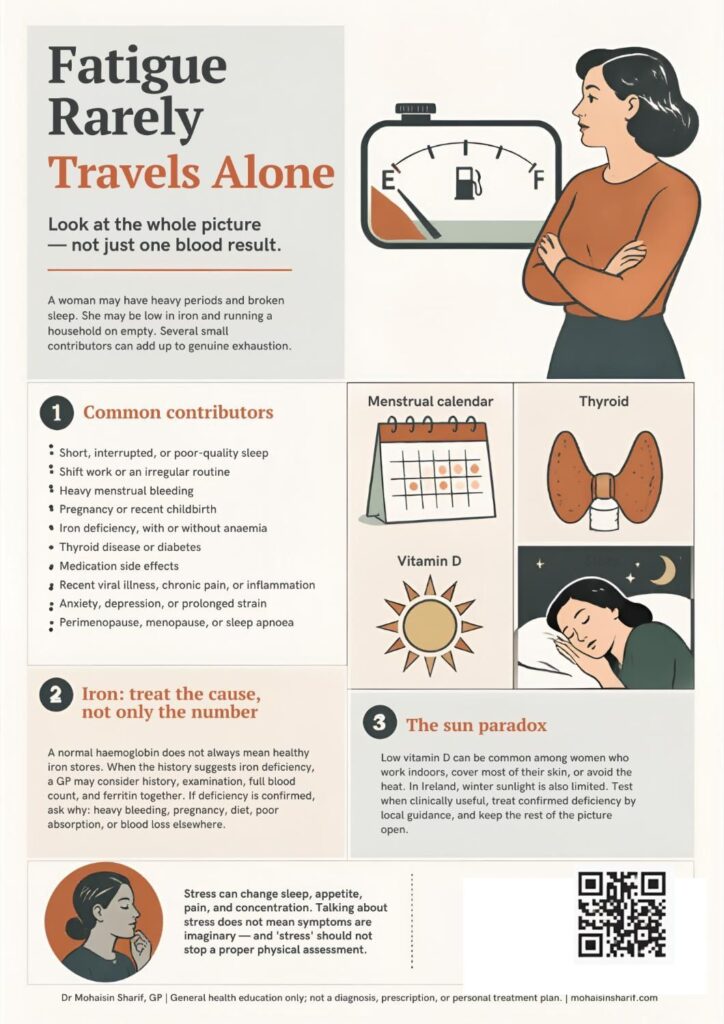
What “tired” actually means
“Tired” is not a diagnosis. Different women use the same short word for very different bodies.
One woman means she could fall asleep at her desk.
Another means her muscles feel weak.
One says … her brain is foggy.
She becomes breathless on stairs she used to take two at a time.
One wakes as tired … as when she went to bed.
Another pays for a normal day with a crash the next morning.
One has no emotional energy left for the people she loves.
That is why a useful consultation starts with questions, not with a printed blood-test form.
I may ask:
- When did this start … suddenly, or so slowly you only noticed later?
- Is this sleepiness, weakness, breathlessness, or mental drain?
- Do you wake feeling refreshed?
- Are your periods heavy, prolonged or irregular?
- Have you noticed dizziness, palpitations or weight change?
- Do you snore, gasp or choke in your sleep?
- Has mood, motivation or enjoyment changed?
- Is pregnancy possible?
- Which medicines, supplements or herbal remedies do you take?
- What happens the day after physical or mental effort?
A few focused questions can turn “I’m tired” into a clinical story.
The NHS advises seeing a GP when unexplained tiredness has lasted several weeks, affects daily life, or comes with other symptoms such as weight loss, mood change, or abnormal breathing during sleep.
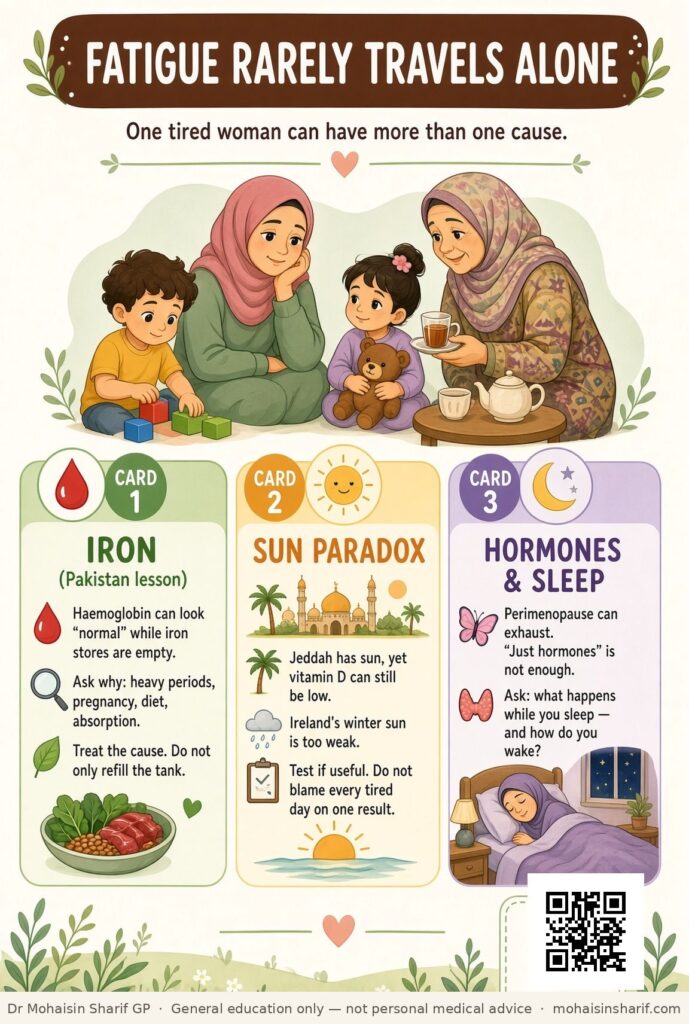
Fatigue rarely travels alone
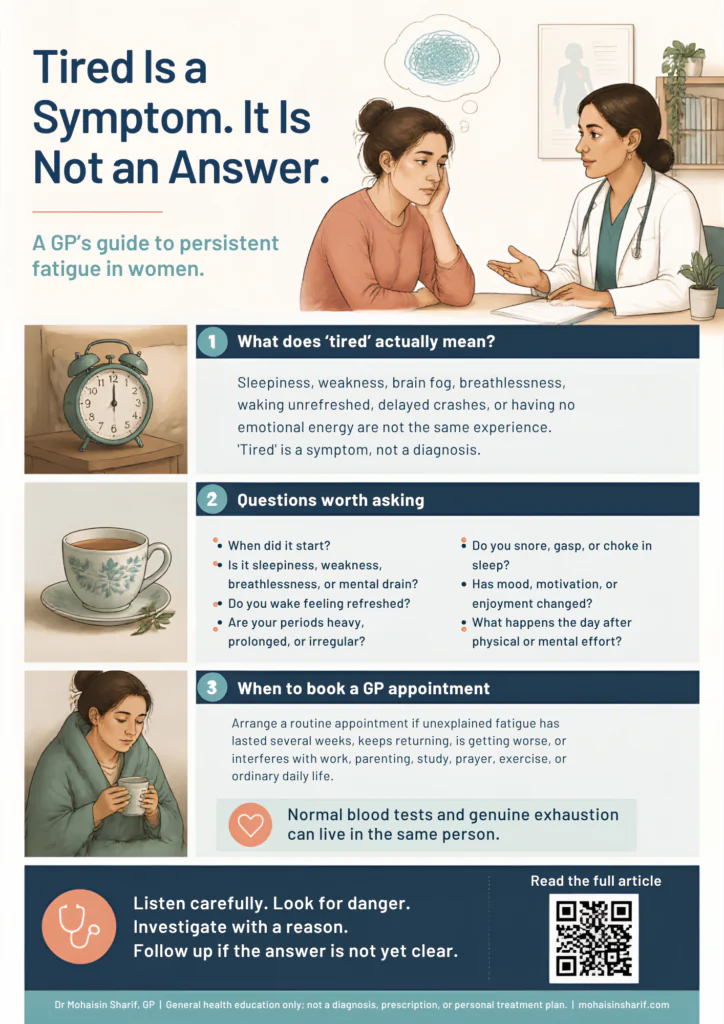
A woman may have heavy periods and broken sleep.
She may be low in iron and running a household on empty.
She may be in perimenopause and caring for children and a parent.
Common contributors include:
- Short, interrupted or poor-quality sleep
- Shift work or an irregular routine
- Heavy menstrual bleeding
- Pregnancy or recent childbirth
- Iron deficiency, with or without anaemia
- Thyroid disease
- Diabetes
- Medication side effects
- A recent viral illness
- Chronic pain or inflammation
- Anxiety, depression or prolonged strain
- Perimenopause or menopause
- Sleep apnoea
- Post-viral fatigue or ME/CFS
Talking about stress does not mean the symptoms are imaginary. Strain changes sleep, appetite, pain and concentration. At the same time, “stress” should never become a shortcut that stops a proper physical assessment.
What Pakistan taught me about iron
In Pakistan, anaemia in women of reproductive age remains a serious public-health problem. Recent WHO-linked estimates still place the country in a high-burden group … close to one in two women aged 15 to 49.
A full blood count is a sensible first test when the story points that way. Haemoglobin, though, is not the whole iron story.
A woman can have a “normal” haemoglobin and still have empty iron stores. That pattern is often called iron deficiency without anaemia. It matters in someone with heavy periods, repeated pregnancies, limited dietary iron, gut symptoms, or unexplained fatigue.
In that situation, ferritin is more useful than stopping at, “Your blood count is fine.” Current clinical reviews advise using history, examination, full blood count and ferritin together when iron deficiency is suspected. Ferritin also needs care in interpretation: inflammation can push the number up and hide deficiency.
Iron tablets should not be an automatic reply to every tired woman. If deficiency is confirmed, the next question is why … heavy bleeding, pregnancy, diet, poor absorption, or blood loss somewhere else.
Treat the cause. Do not only refill the tank.
The Saudi paradox … and the Irish winter
Saudi Arabia has abundant sun. Low vitamin D is still common, especially among women who work indoors, cover most of their skin, or avoid the heat of the day. Muscle ache and low energy can travel with deficiency … but those symptoms are not specific to vitamin D.
Two mistakes follow.
The first is never thinking of vitamin D when the history fits.
The second is blaming every episode of fatigue on one low result while ignoring periods, sleep, thyroid disease, mood, medicines or another condition.
Ireland tells a different solar story. From late autumn to early spring the sun sits too low for reliable vitamin D production. That is why Irish guidance treats winter supplementation as ordinary life, not a wellness trend.
The better rule in all three places is the same:
Test when it is clinically useful. Treat a confirmed deficiency by local guidance. Keep the rest of the picture open.
Hormones, sleep, and the night you do not remember
For a woman in her forties or fifties, fatigue may be tied to perimenopause. “It’s just hormones” is still not enough.
Changing periods, hot flushes, night sweats, broken sleep, mood shifts, joint ache and brain fog can add up to genuine daytime exhaustion. In otherwise healthy people aged 45 or over with typical symptoms, NICE advises that perimenopause or menopause can usually be recognised clinically … without routine hormone blood tests.
Sleep itself needs a proper conversation.
A woman can spend eight hours in bed and still sleep badly. Loud snoring, gasping, witnessed pauses in breathing, morning headaches and heavy daytime sleepiness should raise the possibility of sleep apnoea.
The question is not only, “How many hours do you sleep?”
It is also, “What happens while you are asleep … and how do you feel when you wake?”
When “exercise more” is the wrong sentence
Most people benefit from movement they can recover from. It is not safe as blanket advice for every kind of fatigue.
Some patients manage a shopping trip or a demanding workday, then “crash” hours or days later. The worsening is delayed, out of proportion, and slow to settle. That pattern is called post-exertional malaise. It is a core feature of ME/CFS.
ME/CFS stands for myalgic encephalomyelitis/chronic fatigue syndrome, which is a serious, long-term illness that causes extreme, disabling tiredness that does not get better with rest.
NICE recommends suspecting ME/CFS when the characteristic symptoms have lasted at least six weeks in adults, and confirming the diagnosis after three months if they persist and another condition does not explain them. NICE no longer recommends programmes built on fixed, automatic increases in exercise. Management should respect the person’s limits and avoid repeatedly triggering a crash.
This does not mean every tired patient has ME/CFS. It means one question is worth asking:
“How do you feel the day after activity?”
What a GP might & should check … and what extra tests cannot do
There is no single “fatigue panel” that fits every woman. Tests should follow age, symptoms, menstrual history, medicines, examination and risk.
Depending on the story, a GP may consider:
- Full blood count
- Ferritin or other iron studies
- Thyroid function
- Kidney and liver function
- Blood glucose or HbA1c
- Inflammatory markers
- Pregnancy testing
- Vitamin B12 or folate
- Vitamin D
- Coeliac screening
- Other targeted tests driven by symptoms
Blood pressure, pulse, weight and a focused examination can be just as informative as another vial of blood.
More tests are not automatically better. Untargeted testing finds harmless borderline numbers that do not explain the fatigue. Conversely, normal routine results do not make the symptoms unreal.
Sometimes the answer arrives over two or three visits, not one.
A two-week diary that actually helps
Before the appointment, a simple diary often tells us more than a second set of “routine” bloods.
For two weeks, note:
- Bedtime, waking time and sleep quality
- How refreshed you feel in the morning
- Period dates and heaviness
- Meals, fluids and caffeine
- Medicines and supplements
- Stressful or emotionally heavy days
- Physical and mental activity
- Symptoms that appear later, or the next day
Do not overhaul your whole life overnight. Choose one manageable step: a regular waking time, fewer late caffeinated drinks, more consistent meals, or asking someone to take one exhausting job off your list.
When energy is limited, occupational-therapy principles used in Irish practice are blunt and useful: plan, pace, prioritise, and rest before you are empty … not after.

Do not wait for these
Seek urgent medical help if tiredness comes with:
- Chest pain or severe breathlessness
- Fainting, confusion or collapse
- Sudden one-sided weakness or difficulty speaking
- Black stools, vomiting blood or uncontrolled bleeding
- Severe or rapidly worsening palpitations
- Persistent fever or drenching night sweats
- Unexplained weight loss
- Severe hopelessness or thoughts of self-harm
Book a routine GP appointment if fatigue has lasted several weeks, keeps returning, is getting worse, or is interfering with work, parenting, study, prayer, exercise or ordinary daily life.
The sentence worth hearing
A rushed clinic has a favourite ending.
“It’s stress.”
“Your bloods are normal.”
“Try to rest more.”
The woman leaves feeling unheard. The symptom stays.
A better conversation does not promise that one blood test will solve the week. It asks:
What has changed in this woman’s body, sleep, periods, medicines, load or emotional life … and what can we safely improve first?
Whether the room is in Pakistan, Saudi Arabia or rural Ireland, the starting point does not change.
Listen carefully.
Look for danger.
Investigate with a reason.
Make a realistic plan.
Follow up if the answer is not yet clear.
She is not “just tired.”
Tired is the opening line.
It is not the diagnosis.
About the author
Dr Mohaisin Sharif is a PMDC, SCFHS and Irish Medical Council–registered General Practitioner with more than five years of full-time independent practice in Pakistan and Saudi Arabia. He is preparing to bring that work into Irish general practice. His clinical interests include women’s health, family medicine, safe triage and clear health education for the communities he serves.
Disclaimer
This article is for general health education only. It is not a diagnosis, prescription or personal treatment plan, and it does not replace a consultation with your own doctor. Persistent fatigue has many possible causes. Suitable tests depend on your history, examination, medicines and local clinical guidance. Seek urgent medical care for severe, sudden or rapidly worsening symptoms, or if you have thoughts of self-harm.
References and further reading
- World Health Organization. WHO global anaemia estimates, 2025 edition / Global Health Observatory — anaemia in women of reproductive age. Pakistan remains in a high-burden group (around 47% of women aged 15–49 in 2023 World Bank / WHO-linked figures).
- Sholzberg M, Hillis C, Crowther M, Selby R. Diagnosis and management of iron deficiency in females. CMAJ. 2025;197(24):E680–E687.
- Alzaheb RA. The prevalence of hypovitaminosis D and associated risk factors among women of reproductive age in Saudi Arabia: a systematic review and meta-analysis. J Clin Med Res. 2018.
- NICE. Menopause: identification and management (NG23). Last reviewed April 2026.
- NICE. Myalgic encephalomyelitis (or encephalopathy) / chronic fatigue syndrome: diagnosis and management (NG206).
- Health Service Executive (Ireland). Energy conservation principles used in occupational therapy (plan, pace, prioritise, rest before exhaustion).
- NHS. Tiredness and fatigue