Asking for help is not a failure. It is a step towards recovery, stability, and a better quality of life … 😊
Many people delay asking for help with stress, anxiety, low mood, or difficult thoughts because they fear being ‘labelled‘.
It can feel as though a diagnosis might change how others see you … or how you see yourself. But getting
support is not about placing a permanent tag on you. It is about understanding what you are going through and finding the right help, at the right time, in a way that respects your choices.
Is it normal to fear a mental health label?
Yes. Many people worry about being judged by family, friends, employers, or even themselves. Stigma or Myth around mental health is still real unfortunately, so this fear is understandable.
But needing support does not mean you are weak, broken, or ‘different’. Mental health difficulties are common human experiences. Asking for help is
a practical and courageous step towards feeling better.
Does a diagnosis define who I am?
No. A diagnosis is not your identity.
It is simply a medical term that helps describe a pattern of symptoms you may be experiencing at this time. It can help you and your healthcare professional decide what support may be useful …
A helpful question is not only, What is wrong with me? but also, What has happened to me?
Stress, loss, trauma, poor sleep, physical illness,
relationship difficulties, work pressure, and many other life experiences …. can affect mental wellbeing.
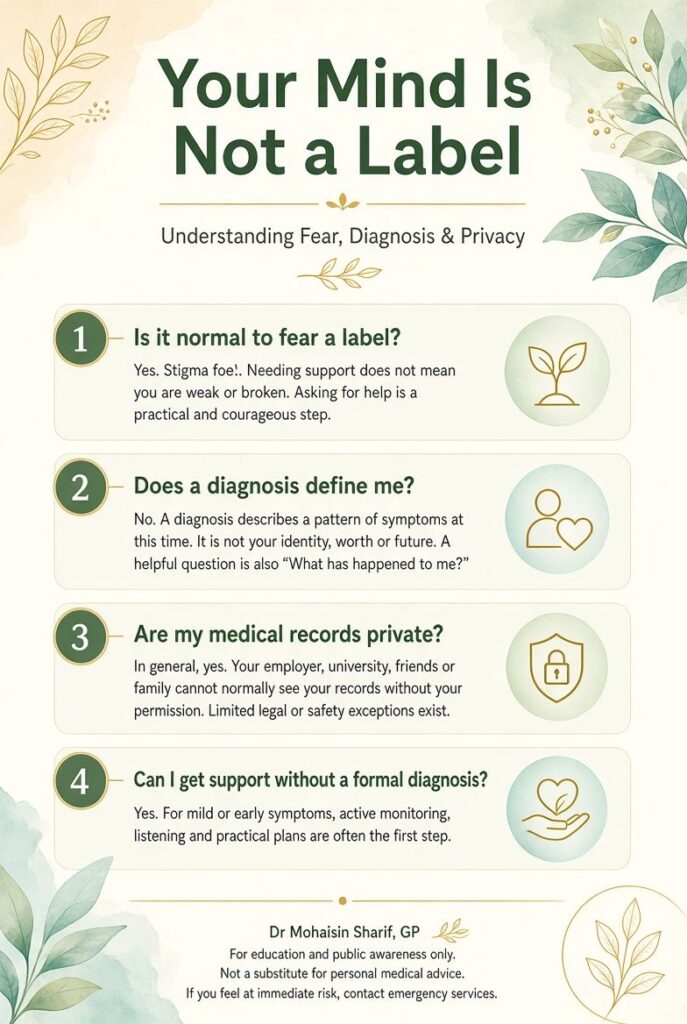
Are my medical records private?
In general, yes. Your health information is private and confidential.
Your employer, university, friends, or family cannot normally see your medical records without your permission. There are a few legal and safety-related
exceptions, and your healthcare professional can explain these clearly if they apply to you in unavoidable circumstances.
You deserve a safe space to speak honestly about how you are feeling.
Can I get support without a formal diagnosis?
Yes. You do not always need a formal diagnosis before receiving support.
For mild or early symptoms, your GP may suggest active monitoring. This means checking in with you over time, talking through what is happening,
offering practical advice, and reviewing your progress before deciding whether more treatment is needed.
As per my experience, the most helpful first step is simply having someone listen, taking symptoms seriously, and making a plan together.
What if I do not want medication?
You have choices. Medication is not the only form of mental health support.
For mild to moderate symptoms, your GP may discuss options such as:
- Talking therapy, including cognitive behavioural therapy (CBT)
- Support for relationship, family, work, or life difficulties
- Regular physical activity
- Improving sleep habits
- Reducing alcohol or drug use where relevant
- Building routine, social connection, and coping skills
- Self-help resources, guided programmes, or follow-up appointments
Medication may be helpful for some people, especially when symptoms are more severe or persistent. But it should be part of a conversation, not something imposed on you.
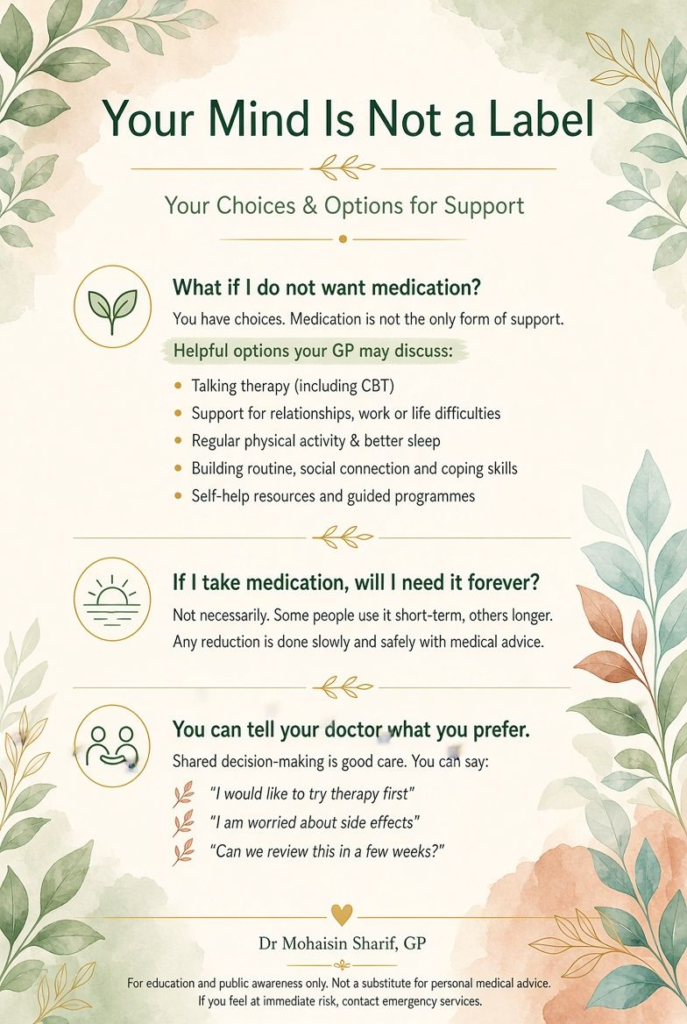
If I take medication, will I need it forever?
Not necessarily.
Some people use medication for a short time. Others benefit from it for longer. The right plan depends on your symptoms, previous experiences, physical health, preferences, and how you respond to treatment …
If you and your doctor later decide that you are ready to reduce or stop medication, this is usually done slowly and safely. Do not stop mental health medication suddenly without medical advice, as this can cause withdrawal symptoms or a return of symptoms.
Can I tell my doctor what I prefer?
Absolutely. Good care should involve shared decision-making. This means your healthcare professional brings medical knowledge, while you bring your own experiences, expectations, values, culture, concerns, and goals.
You can say things like:
- I am worried about being diagnosed.
- I would like to try therapy first.
- I do not feel ready for medication.
- I am concerned about side effects.
- Can we review this again in a few weeks?
- I need this explained in simpler words.
There is no need to have the perfect words. Being honest about what you want and what worries you helps your GP make a plan that suits you better.
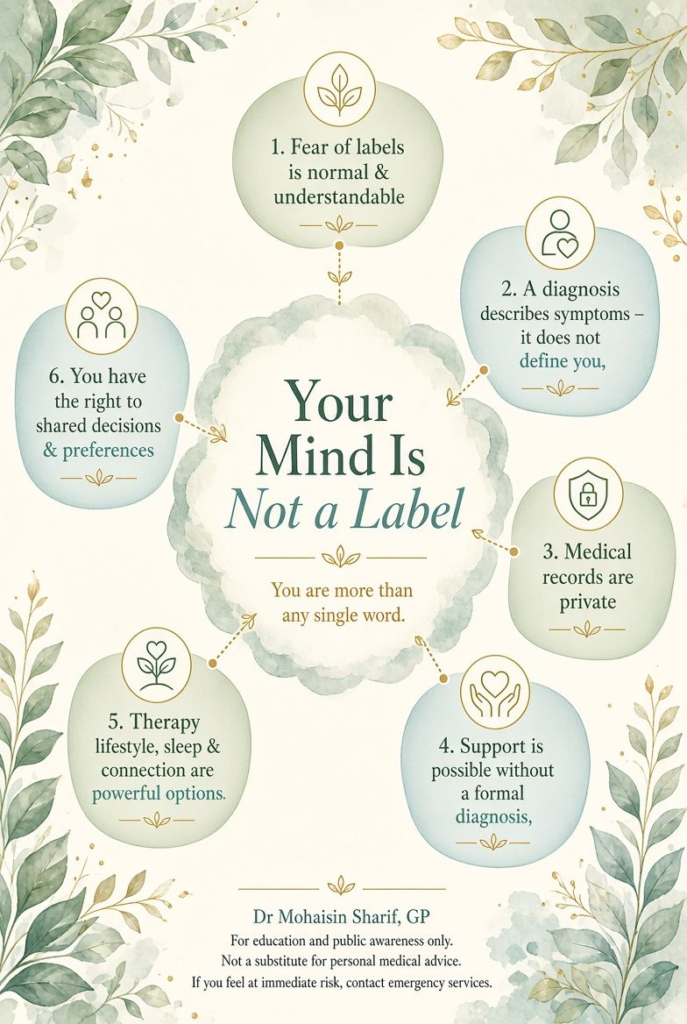
Key takeaways …
- Fear of being labelled is common, understandable, and should never stop you from seeking support.
- A mental health diagnosis describes symptoms; it does not define your personality, worth, or future.
- Your medical information is private and should not be shared without your permission, except in limited legal or safety situations.
- You can often receive support without a formal diagnosis, especially when symptoms are mild or new.
- Therapy, lifestyle support, sleep, exercise, and social connection can all be important parts of care.
- Medication is one option, not the only option, and it does not automatically mean lifelong treatment.
- You have the right to ask questions, express your preferences, and take part in decisions about your care.
Asking for help is not a failure. It is a step towards recovery, stability, and a better quality of life … 😊
About the Author
Dr Mohaisin Sharif is a triple-licensed General Practitioner and medical writer, registered with the Irish Medical Council, SCFHS, and PMDC. He provides evidence-based, patient-centred health education.
Disclaimer:
This article is for education and public awareness only. It is not a substitute for personal medical advice, diagnosis, treatment, or emergency care.
Please speak with a qualified healthcare professional if you are worried about your mental health.
If you feel at immediate risk of harming yourself or someone else, contact your local emergency service or go to the nearest emergency department straight away.
References:
- NICE: Depression in adults—treatment and management (NG222)
- Mayo Clinic: Overcoming the stigma of mental illness
- British Psychological Society: Power Threat Meaning Framework
- RACGP: Shared decision making
- RACGP: Antidepressant deprescribing resource
- European Psychiatric Association: Building trust in mental health services
- The Lancet Commission on ending stigma and discrimination in mental health